|
|
Mechanisms of Viral Entry, Replication and Assembly
|
|
Project: INTRACELLULAR DYNAMICS OF HIV-GAG
Andrea Gramatica
Assembly of the human immunodeficiency virus 1 (HIV-1) is determined by a
single gene that encodes a structural polyprotein precursor, Pr55 Gag
polyprotein, and may occur at the plasma membrane or within late endosomes/multivesicular
bodies (LE/MVB). Irrespective of where assembly occurs, the assembled particles
are released from the plasma membrane of the host cell. The Gag protein is the
only viral component required for the assembly of virus-like particles (VLPs).
Participation of host cell components is particularly required for any of the
many Gag-encoded functions.
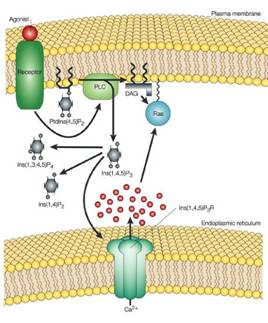
Previous studies have shown that the increase of intracellular calcium
concentration, resulting from the activation of the phospholipase C (PLC)
pathway (Figure 1), is required for efficient Gag trafficking and VLPs release.
We utilize different fluorescence microscopy methods (e.g., FLIM/FRET, TIRFM,
FACS etc.) and pharmacological inhibitions as principal tool to investigate how
the PLC pathway is activated upon expression of Gag in different cell lines.
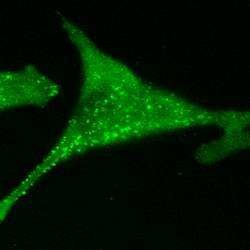
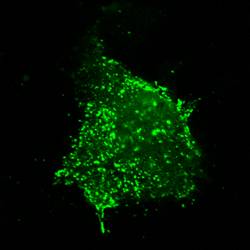
We are also interested to study the intracellular localization of Gag (Figure
2), possible interactions between Gag and PLC and the role of calcium in the Gag
localization process and VLPs release.
 |
|
 |
|
Figure 1 PLC signalling pathway and intracellular calcium increase.
Adapted from Peter J. Cullen et al., Nature Reviews Molecular
Cell Biology 3, 339-348 (May 2002).
|
Figure 2 Confocal fluorescence microscopy of HeLa cell (A) and Cos-7
cell (B) transfected with Gag-EGFP. The green spots presumably
represent Gag aggregates. |
Results:
References: