
News

Publications, preprints, grants and lab news.

Press releases and talks · RSS feed


Paper

The Druantia defence system recognises single-stranded DNA

Together with the groups of Markus Wahl and Chase Beisel, we characterised the compact type III-A Druantia system of Escherichia coli. Its two proteins, DruE and DruH, clear phage infections without harming the host cell.

DruE forms a dimer that binds exposed single-stranded DNA and unwinds DNA with 3′-to-5′ directionality, using lock, wedge and clamp elements for strand separation. DruH interacts indirectly with DruE and other host proteins in uninfected cells; infection dissociates the complex. These results identify exposed single-stranded DNA as a trigger of bacterial immunity.

Himpich S, Gaudin T, Grass LM, … Erhardt M, Antelmann H, Beisel CL, Wahl MC. Cell Reports 45 (2026). doi:10.1016/j.celrep.2026.118021
Lab

María José Giralt Zúñiga defended her PhD thesis

María José Giralt Zúñiga defended her thesis “Cost-benefit trade-offs and evolutionary consequences of peritrichous flagellation in Salmonella”. Congratulations, Dr. Giralt Zúñiga.


Preprint

Preprint: the cost-benefit trade-off of peritrichous flagellation

We expressed the flagellar master regulator flhDC of Salmonella enterica from inducible or constitutive promoters and obtained strains from nearly non-flagellated to hyperflagellated cells. More flagella reduced the growth rate: the flagellar share of the proteome grew mainly at the expense of ribosomes, and flagellin synthesis was the largest cost. More flagella also improved spreading, swimming speed and competitive fitness in structured environments. A proteome-allocation model predicts that the benefit of motility saturates near a flagellar investment of 3% of the proteome.

Try the interactive motility simulation: strains with fewer or more flagella than the wild type swim side by side, in liquid and in agarose.

The cost-benefit trade-off of flagellation (animation, 59 s).

Giralt-Zúñiga MJ, Jahn M, Franklin JL, … Charpentier E, Dufour YS, Erhardt M. bioRxiv (2026), preprint. doi:10.64898/2026.08.20.746045


Preprint

Preprint: BactoMate, a platform for the analysis of bacterial microscopy data

BactoMate is an open-source program with a graphical interface for microscopy data of bacteria. It combines file conversion, segmentation, quality control, fluorescence and foci quantification, cell tracking and lineage reconstruction in one workflow. The program records all parameters with the results, so that an analysis can be repeated with the same settings. The preprint shows applications to fluorescence imaging, swimming assays, microcolonies, phage infection and microfluidic time series.

Hallenga L, Fornoff S, Pesch M, Kohlheyer D, Ahmad S, Hoer J, Erhardt M, Popp PF. bioRxiv (2026), preprint. doi:10.64898/2026.08.06.743177


Preprint

Preprint: how nutrients set the number of flagella per cell

Together with the group of Haralampos Hatzikirou, we measured flagellar basal bodies in single Salmonella cells over time and described the data with a stochastic model. In the model, an RflP-dependent regulatory memory sets a target number of flagella, and synthesis, partitioning at division and growth determine the distribution around this target. The fitted model predicted the flagellar number in a nutrient condition that was not used for fitting.

Barua A, Giralt-Zúñiga M, Erhardt M, Hatzikirou H. bioRxiv (2026), preprint. doi:10.64898/2026.07.10.737737


Paper

Queuosine and i6A modifications of tRNATyr prevent frameshifting

Together with the group of Ann Ehrenhofer-Murray, we analysed queuosine at the wobble position of tRNATyr and (ms2)i6A at position 37. E. coli that lacked both modifications showed a severe growth defect, increased +1 frameshifting at tyrosine codons and protein aggregation. The functional interplay is conserved in Schizosaccharomyces pombe.

Sun Y, Kaur N, Zain H, … Erhardt M, Barras F, Limbach PA, Ehrenhofer-Murray AE. Nucleic Acids Research 54 (2026). doi:10.1093/nar/gkag664


Preprint

Preprint: typhoidal Salmonella use preassembled flagella inside host cells

Together with the group of Michael Hensel, we followed the flagella that Salmonella assembles before it enters epithelial cells. The bacteria keep these flagella during invasion. Inside the Salmonella-containing vacuole the flagella are disassembled; in the cytosol, autophagy targets them. The human-restricted serovar Paratyphi A uses its preassembled flagella for motility inside the host cell and to escape from the vacuole.

Salmonella Paratyphi A moving inside a host cell.

Lehmann M, Kellermann M, Holtmannspoetter M, Kurre R, Hensel M, Erhardt M. bioRxiv (2026), preprint. doi:10.64898/2026.06.15.732394


Preprint

Preprint: the last bacterial common ancestor encoded a complex flagellum

Only 24 flagellar genes were known to be conserved across bacteria. Together with the groups of Igor Zhulin, Morgan Beeby and Daniel Kearns, we searched a large set of bacterial genomes with profile- and sequence-based methods and gene-neighbourhood data. We found 28 more flagellar gene families that originated before the main diversification of bacteria. The ancestral flagellum thus had 52 genes, including the complete export apparatus, basal body, axial structures, stator units and regulatory checkpoints.

Selcuk B, Andrianova EP, Beeby M, Kearns DB, Erhardt M, Zhulin IB. bioRxiv (2026), preprint. doi:10.64898/2026.06.11.731707


Preprint

Preprint: molecular basis of the Druantia defence system

Together with the group of Nicholas Taylor, we studied a Druantia system that consists of only two proteins, DruH and DruE. The two proteins are sufficient for defence against phages. Cryo-EM structures show an asymmetric DruE dimer that unwinds double-stranded DNA with a 3′ overhang. DruH binds single-stranded DNA, and ATP at physiological concentrations inhibits this binding.

Hu H, Popp PF, Rutbeek NR, … Harms A, Erhardt M, Taylor NMI. bioRxiv (2026), preprint. doi:10.64898/2026.05.12.722862


Paper

Structure of the sheathed flagellar filament of Vibrio alginolyticus

In Vibrio species, a membranous sheath that extends from the outer membrane encloses the flagellar filament. Together with the group of Julien Bergeron, we combined cryo-EM, cryo-electron tomography and genetics to resolve the sheathed flagellum of Vibrio alginolyticus.

The filament is a canonical 11-stranded supercoil of the flagellin FlaD2 inside a bilayered sheath. The filament surface is highly electronegative. This suggests that electrostatic repulsion between filament and sheath reduces friction during rotation. The cap protein FliD contains an additional domain that may coordinate sheath assembly with filament elongation.

Qin K, Einenkel R, Zhao W, Kühne C, Atherton J, Erhardt M, Bergeron JRC. Nature Communications 17 (2026). doi:10.1038/s41467-026-71203-7


Lab

Rosa Einenkel defended her PhD thesis

Rosa Einenkel defended her thesis “Structural and mechanistic insights into assembly and function of bacterial flagella”. Congratulations, Dr. Einenkel.


Paper

Structure of a contractile injection system of Salmonella enterica subsp. salamae

Extracellular contractile injection systems are phage-derived nanomachines that deliver effectors into target cells. Together with the group of Nicholas Taylor, we determined the cryo-EM structure of the system encoded by S. enterica subsp. salamae. The structure shows a sheath architecture that differs from that of other contractile injection systems, a cage-like shell around the central spike and an associated integral membrane protein. Our data indicate that the system interacts with the inner membrane. Based on these structural features, we identified a previously unannotated cluster of contractile injection systems.

Ejaz RN, Funke K, Kielkopf CS, … Nielsen ML, Erhardt M, Taylor NMI. Nature Communications (2026). doi:10.1038/s41467-026-71989-6


Preprint

Preprint: crystal structure of the flagellin of E. coli Nissle 1917

Together with the groups of Alexander Weber and Michael Hensel, we contributed to the analysis of the flagellin FliC of the probiotic strain E. coli Nissle 1917. Its crystal structure at 1.2 Å shows a hypervariable region that forms an outer domain around the conserved filament core. Removal of the linker to this region reduced protein stability and motility, whereas recognition by TLR5 changed only moderately.

Jakob J, Braun MB, Hipp K, … Frick J-S, Weber ANR. bioRxiv (2026), preprint. doi:10.64898/2026.03.27.714778


Paper

Conjugative pili restructure biofilms

Together with the group of Carey Nadell, we followed transfer of the F-like plasmid pED208 inside E. coli biofilms in microfluidic chambers. Conjugation was efficient until the cell density reached a threshold associated with high matrix secretion. Conjugative pili enabled matrix-deficient cells to form dense biofilms with increased antibiotic and phage tolerance. Plasmid-carrying cells dispersed less than plasmid-free cells.

Winans JB, Delgadillo-Guevara M, Popp PF, Erhardt M, Nadell CD. Current Biology 35 (2025). doi:10.1016/j.cub.2025.11.022


Paper

FliI ATPase activity is required for timely substrate switching

The flagellar type-III secretion system exports its building blocks in a defined order. Rosa Einenkel analysed Salmonella strains with mutations in the catalytic domain of the ATPase FliI. Minimal ATPase activity was sufficient for early export and hook-basal-body assembly. Efficient substrate-specificity switching and export of late substrates required near-wild-type activity. The mutants showed delayed class 3 gene expression, prolonged early secretion and impaired filament assembly, although FliI localisation and oligomerisation were normal. These data link ATPase activity to substrate switching in type-III secretion.

Einenkel R, Kühne C, Delgadillo-Guevara M, Hallenga L, Goosmann C, Erhardt M. mBio (2025). doi:10.1128/mbio.02354-25


Grant

Einstein Foundation funds a Berlin/HUJI research project

The Einstein Foundation Berlin approved our Einstein Berlin/HUJI research project (BJ-2025-857) with the group of Orna Amster-Choder at the Hebrew University of Jerusalem.


Review

Review on regulation, assembly and function of the flagellum

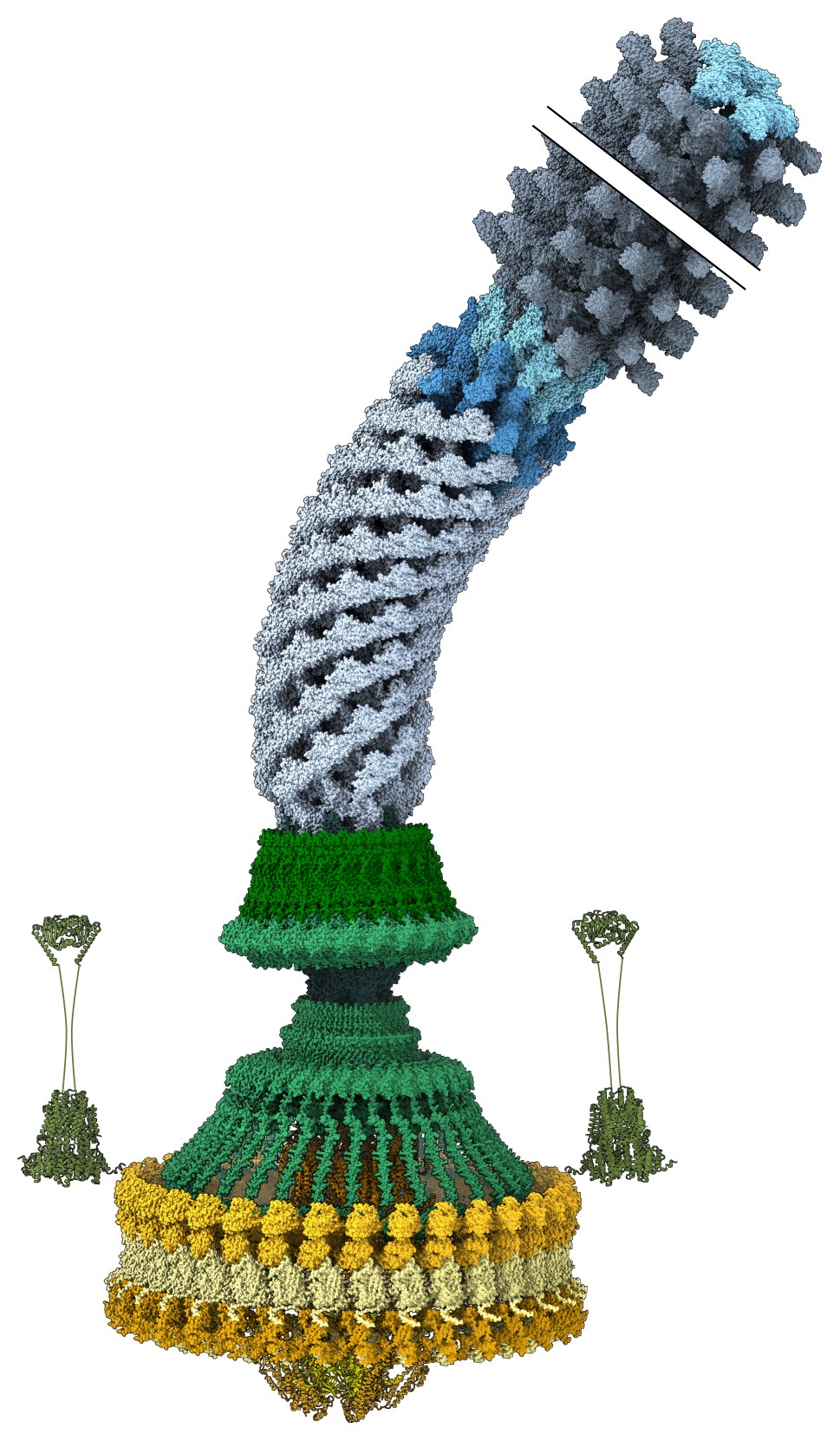
Our review in Microbiology and Molecular Biology Reviews covers recent progress on the structure, assembly and regulation of the flagellum: hierarchical gene regulation, motor mechanics and new structures of the core components. The review also discusses the legacy of Howard Berg and open questions that require single-cell observations.

The complete flagellum, assembled from cryo-EM structures, as shown in the review. Rendering: Rosa Einenkel.

Einenkel R, Halte M, Sawant SA, Erhardt M, Wadhwa N, Popp PF. Microbiology and Molecular Biology Reviews (2025). doi:10.1128/mmbr.00092-22


Grant

DFG funding in SPP 2389 for research on conjugative pili in biofilms

The DFG funds our project “Conjugative pili shape spatial and functional differentiation in multicellular bacterial biofilms” in the priority programme SPP 2389 “Emergent functions of bacterial multicellularity” for three years.


Paper

FliO is a conserved core component of the flagellar type-III secretion system

Together with the groups of Igor Zhulin and David Hendrixson, we searched more than 30,000 representative bacterial genomes for FliO, a protein that is poorly conserved at the sequence level. FliO is present in about 95% of genomes that encode the export-gate proteins FliP, FliQ and FliR. This suggests that FliO is an ancestral core component of the flagellar type-III secretion system. About 40% of bacterial genomes contain flagellar genes. In Campylobacter jejuni, FliO and its AMIN domain are needed for efficient flagellation, stability of FlhB and host colonisation.

Andrianova EP, Dobbins AL, Erhardt M, Hendrixson DR, Zhulin IB. PNAS 122 (2025). doi:10.1073/pnas.2512476122


Paper

YebC enhances translation of proline-rich motifs

Together with the group of Emmanuelle Charpentier, we identified the conserved RNA-binding protein YebC as a translation factor. YebC interacts with 23S rRNA near the peptidyl-transferase centre. In the absence of YebC, ribosome pausing at proline-rich motifs increased in Streptococcus pyogenes. Experiments in Salmonella Typhimurium and in an in vitro translation system support this function.

Ignatov D, Shanmuganathan V, … Funke K, Erhardt M, Frese CK, Charpentier E. Nature Communications 16 (2025). doi:10.1038/s41467-025-60687-4


Paper

Structure of the complete extracellular flagellum

Together with the group of Julien Bergeron, we solved cryo-EM structures of the complete extracellular flagellum of Salmonella, including the pentameric FliD cap (3.7 Å) and the FlgKL hook-filament junction (2.9 Å). We also solved the structure of the Campylobacter flagellum before filament assembly.

The structures and structure-guided mutagenesis revealed intermediates of filament assembly. Movement of the FliD terminal domains and clockwise rotation of the cap enable the incorporation of flagellin. The hook-filament junction acts as a buffer that prevents the transfer of mechanical stress to the filament.

Top view of the density map of the FliD filament cap on top of the filament.

Einenkel R*, Qin K*, Schmidt J, … Beeby M, Erhardt M, Bergeron JRC. Nature Microbiology 10 (2025). doi:10.1038/s41564-025-02037-0


Paper

Swimming requires a minimal filament length of 2.5 µm

We synchronised flagellar assembly in Salmonella and combined live-cell imaging, electron microscopy and biophysical modelling. Swimming required a minimal filament length of about 2.5 µm. Modelling attributes this threshold to an elasto-hydrodynamic instability of the swimming cell.

Stepwise filament labelling confirmed flagellin secretion rates of up to 10,000 amino acids per second. A model of filament growth shows that this rate balances filament elongation against energy consumption.

Swimming speed as a function of filament length (25 s). Movie of all experiments (2 min 46 s).

Halte M, Popp PF, Hathcock D, … Tu Y, Lauga E, Erhardt M, Renault TT. PNAS 122 (2025). doi:10.1073/pnas.2413488122


Lab

Doaa Saleh defended her PhD thesis

Doaa Saleh defended her thesis “Complex regulatory networks of virulence traits in Salmonella Typhimurium”. Congratulations, Dr. Saleh.


Paper

Structure and mechanism of the Zorya anti-phage defence system

Zorya is a widespread anti-phage defence system. Together with the groups of Nicholas Taylor and Simon Jackson, we determined cryo-EM structures of the membrane complex ZorAB. ZorAB has the 5:2 stoichiometry of flagellar stator units and other ion-driven rotary motors. ZorB has a dimeric peptidoglycan-binding domain, and ZorA forms a pentameric coiled-coil tail that projects about 70 nm into the cytoplasm.

The soluble subunits ZorC and ZorD bind DNA and act as a nuclease, respectively. The data support a model in which ZorAB is a proton-driven motor that is activated when a phage perturbs the cell envelope. In this model, the ZorA tail recruits ZorC and ZorD, which degrade the phage DNA.

Proposed mechanism of Zorya (28 s).

Hu H*, Popp PF*, Hughes TCD, … Harms A, Erhardt M, Jackson SA, Taylor NMI. Nature 639 (2025), published online 11 Dec 2024. doi:10.1038/s41586-024-08493-8


Grant

DFG funding in SPP 2330 for research on Zorya

Marc Erhardt and Philipp Popp received funding for two PhD researchers as part of the DFG priority programme SPP 2330 “New concepts in prokaryotic virus-host interactions”. The project studies immune mechanisms of bacteria against bacteriophages with live-cell microscopy, biochemistry and bacterial genetics.


Paper

FlhE prevents the assembly of periplasmic flagella

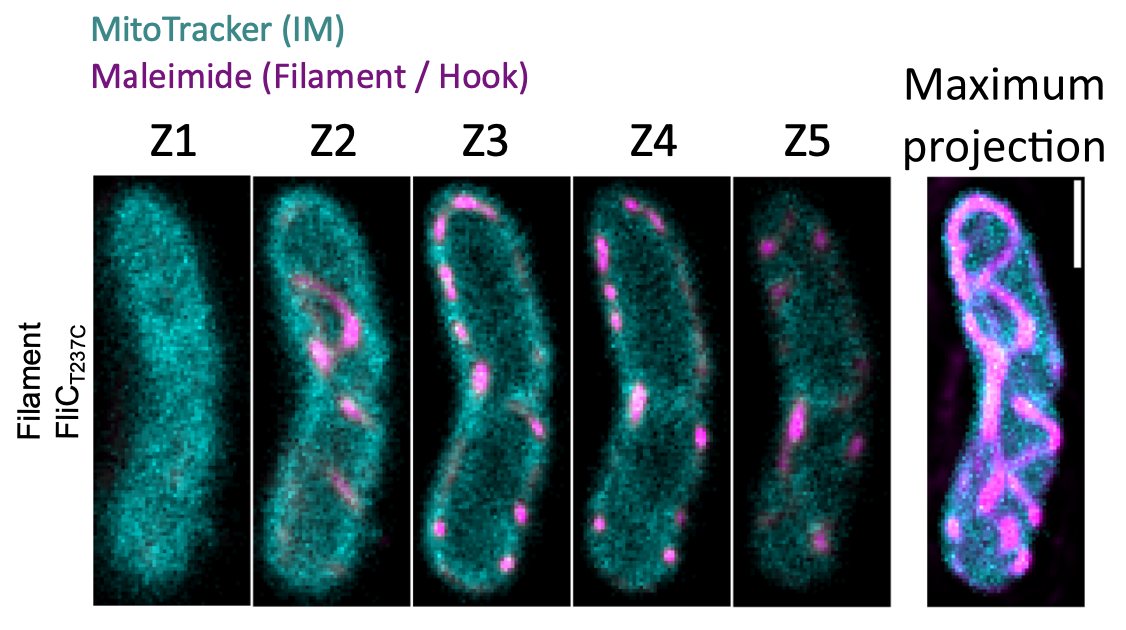
Salmonella mutants that lack the periplasmic protein FlhE assembled flagella in the periplasm. The periplasmic flagella disrupted cell-wall synthesis, which led to a loss of normal cell morphology and to cell lysis. We propose that FlhE functions as a periplasmic chaperone that controls assembly of the rod.

Flagellar filaments (magenta) in the periplasm of a ΔflhE mutant; inner membrane in cyan.

Halte M, Andrianova EP, Goosmann C, Chevance FFV, Hughes KT, Zhulin IB, Erhardt M. Nature Communications 15 (2024). doi:10.1038/s41467-024-50278-0


Grant

DFG large-equipment grant for a five-laser cell sorter

Together with other groups of the Institute of Biology, we obtained a DFG large-equipment grant (Art. 91b GG) for a five-laser cell sorter at Humboldt-Universität zu Berlin.


Grant

DFG large-equipment grant for high-speed structured-illumination microscopy

Together with other groups of the Institute of Biology, we obtained a DFG large-equipment grant (Art. 91b GG) for a high-speed super-resolution live-cell imaging system with photostimulation (iSIM).


Grant

Second funding period in SPP 2225 for research on vacuolar escape

The DFG funds the project “Escape from the Salmonella-containing vacuole: the role of flagella-mediated damage, cytosolic motility and host-cell apoptosis in exit and transmission of Salmonella” for a second period of three years in the priority programme SPP 2225 “Exit strategies of intracellular pathogens”. The project is a collaboration with Michael Hensel (Osnabrück).


Lab

Svenja Fischer defended her PhD thesis

Svenja Fischer defended her thesis “Quality control during assembly and function of the type-III core export apparatus of the bacterial flagellum”. Congratulations, Dr. Fischer.


Paper

The F pilus conducts DNA during conjugation

Together with the group of Christian Lesterlin, we used live-cell microscopy and fluorescent reporters of DNA transfer. The F pilus transferred DNA between physically distant bacteria, in addition to transfer between cells in direct contact.

Distant transfer events between E. coli cells (3 min per frame; scale bar 1 µm).

Goldlust K, Ducret A, Halte M, Dedieu-Berne A, Erhardt M, Lesterlin C. PNAS (2024). doi:10.1073/pnas.2310842120


Grant

ANR-DFG funding for BacCellFactory

The DFG and the ANR fund the project “Development of a bacterial secretion platform for the fast, high-yield and low-cost production of peptides and proteins for diagnostics and biomedicine” (BacCellFactory) for three years, together with the Université de Bordeaux.


Award

Humboldt Prize for Hannah Raasch

Hannah Raasch received the 2023 Humboldt Prize for her Master’s thesis “The consequences of distributed metabolic functions in microbial communities under fluctuating environments”. HU news.


Award

Emmy Noether grant for Gita Naseri

Gita Naseri received a six-year grant from the DFG Emmy Noether Programme for her project “COMPLATn – a comprehensive platform for sustainable biosynthesis of rare natural products in Pichia pastoris”. She now leads her own lab: synbio.hu-berlin.de.


Paper

Ion selectivity of the sodium-driven Vibrio stator unit

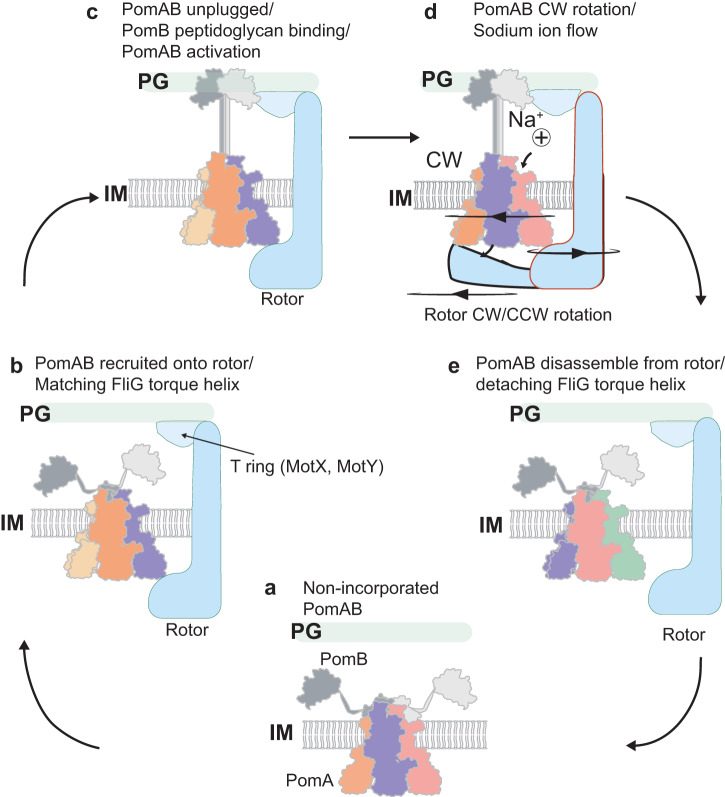
Together with the group of Nicholas Taylor, we determined the structure of the sodium-driven stator unit PomAB of Vibrio. Based on the structure, mutational analyses and molecular dynamics simulations, we proposed mechanisms for ion selectivity and for the incorporation of the stator unit into the rotor.

Proposed model of ion selectivity and rotor incorporation.

Hu H, Popp PF, Santiveri M, … Erhardt M, Taylor NMI. Nature Communications (2023). doi:10.1038/s41467-023-39899-z


Paper

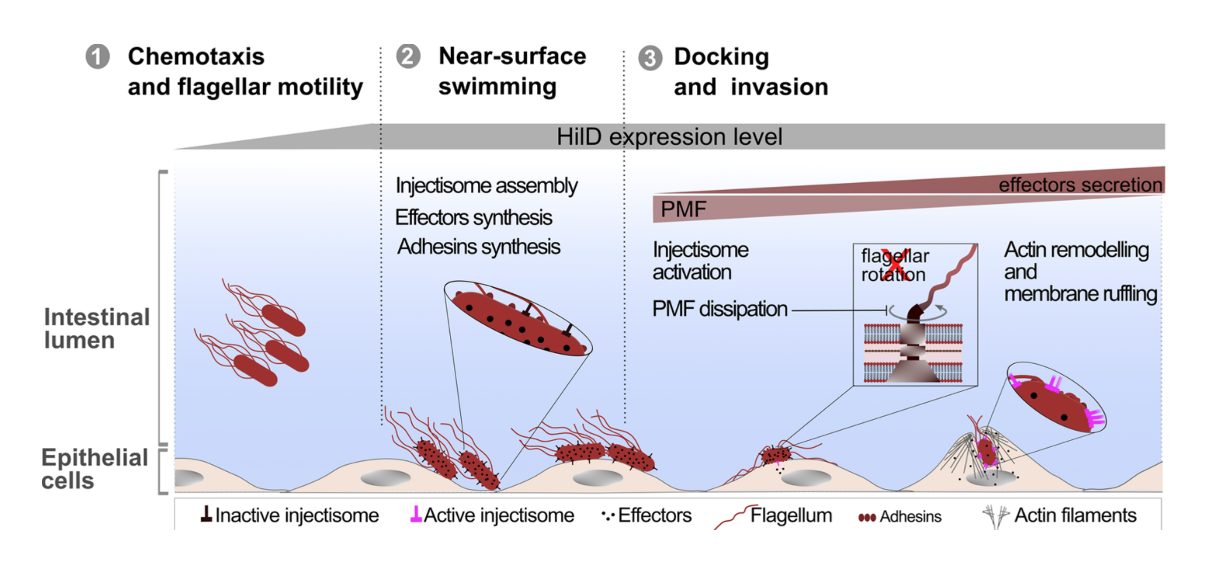
SPI-1 expression reduces the motility of Salmonella

HilD is the master regulator of the SPI-1 injectisome and activates transcription of the flagellar master operon flhDC. Together with the groups of Enrico Klotzsch and Till Strowig, we found that induction of HilD nevertheless reduced the motility of Salmonella. The loss of motility required SPI-1 and depended on the proton motive force and on adhesins.

Proposed model.

Saleh DO, Horstmann JA, Giralt-Zúñiga M, … Strowig T, Erhardt M. PLOS Pathogens (2023). doi:10.1371/journal.ppat.1011451


Lab

Manuel Halte defended his PhD thesis

Manuel Halte defended his thesis “Single-cell analysis of bacterial extracellular filament regulation and assembly”. Congratulations, Dr. Halte.


Award

Elsa Neumann scholarship for Hannah Grabietz

Hannah Grabietz received an Elsa Neumann scholarship of the State of Berlin (NaFöG) for her doctoral project, starting in April 2023.


Grant

DFG renews the project on the flagellar export ATPase

The DFG funds the project “Function of the type-III secretion system-associated ATPase during protein export of the bacterial flagellum” for a further three years.


Grant

Berlin University Alliance funds a joint PhD project with the University of Melbourne

The Berlin University Alliance funds the joint PhD project “Visualising the dynamics of horizontal gene transfer during bacterial conjugation” with the University of Melbourne in its Grand Challenge Initiative Global Health (2022–2025).


Paper

Structure of the flagellar stator unit

Together with the group of Nicholas Taylor, we showed that the stator unit consists of a MotB dimer surrounded by a MotA pentamer. The structures support a model in which the MotA pentamer rotates around the MotB dimer.

The stator unit MotA5B2 (animation of 2026, 16 s).

Santiveri M, Roa-Eguiara A, Kühne C, Wadhwa N, Berg HC, Erhardt M, Taylor NMI. Cell 183 (2020). doi:10.1016/j.cell.2020.08.016


Grant

ERC Consolidator Grant for BacNanoMachine

The European Research Council funds our project BacNanoMachine. The project studies how bacteria coordinate the simultaneous self-assembly of several multi-component nanomachines in one cell. ERC press release.


Grant

VolkswagenStiftung funds a project on cell decision-making

The VolkswagenStiftung funds the project “Deciphering the principles of cell decision-making in multicellular systems: the least microenvironmental uncertainty principle (LEUP)” for five years, together with Haralampos Hatzikirou (Helmholtz Centre for Infection Research), Massimo Locati (Milan), Ioannis Mitroulis (Thrace) and Nir Friedman (Weizmann Institute).