 I am a postdoctoral researcher at the college for Social Sciences and Humanities with the research professorship Curating Digital Objects of Cultural Knowledge and Memory (Tahani Nadim) in Bochum. Before, I worked as a research associate in a DFG-funded project at HU Berlin and TU Munich and studied social and cultural anthropology at HU Berlin, FU Berlin andAix-Marseille Université, France.
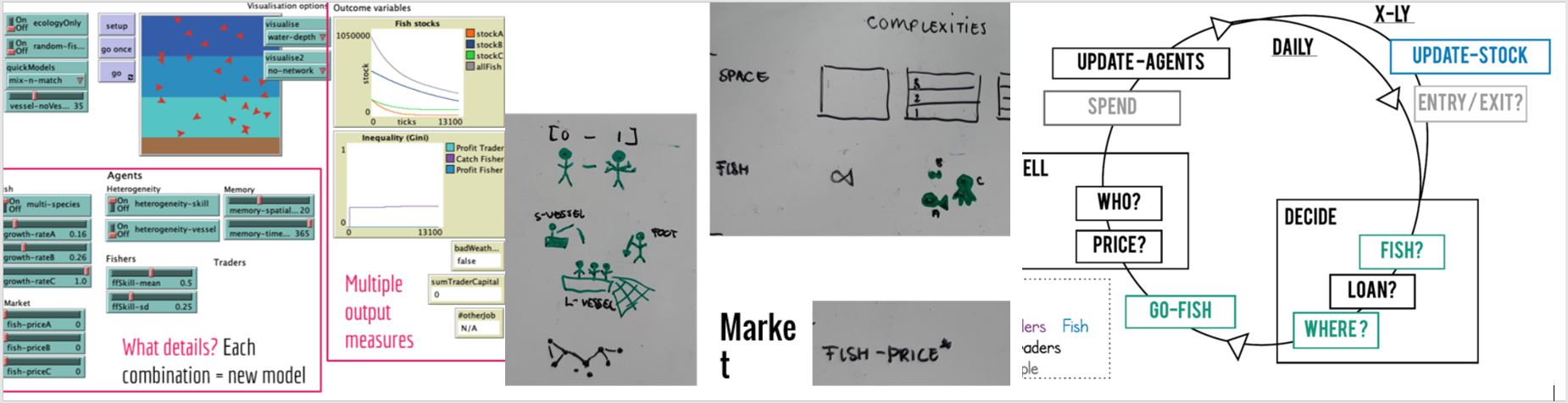
In November 20205 I defended my PhD thesis “Doing difference, materiality and complexity with simulation models: An ethnography of modeling social-ecological relations in interdisciplinary sustainability research”. In the thesis I explored the epistemological, ontological, and ethical dimensions of modelling in interdisciplinary sustainability research as a set of iterative and entangled material-semiotic knowledge practices. This was grounded in ethnographic fieldwork on the construction and use of statistical and numerical models of social-ecological relations in two research groups in Stockholm and Accra. I contributed to the ethnography of modeling and explored the collaborative and co-laborative potential of connecting ethnography and simulation modeling in research on social-ecological relations in ways that do not reduce ethnographic data to modeling input. One important output was the developmentof a framework for doing Situated Modeling together with modelers and non-modelers. I argue that this engagement is necessary for anthropology in the Anthropocene in order to grasp and navigate the deep, dynamic and cross-scale social-ecological changes more-than human life on Earth needs to face, and work towards just sustainability transformations.
I continue to be interested in these kinds of collaboartions and deeply enjoy working in and communicating across interdisciplinary contexts. In my postdoctoral research, I am working with an interdisciplinary team in France, Tunisia, Sweden and the Netherlands towards developing multispecies concepts and methodologies to understand causalities and temporalities of biodiversity decline in two Mediterranean case studies. We will use fieldwork, participatory methods, simulation modeling and archival research to trace the impact on social-ecological relations of the blue crab in the Gulf of Gabès and of salinization in the Camargue and work towards relational governance approaches. More information can be found here.
Contact: anja.klein-c7l [at] ruhr-uni-bochum.de
Find me also at: IRI THEsys | ResearchGate | CECO (Code Ethnography Collective) | ORCiD | LinkedIn
Publications
2025
Situating Bayesian Knowledge: A Case Study of Modelling Pollutant Transfers from Land to Water Journal Article
In: Computational Culture, 2025.
Disentangling the entangled in productive ways: modelling social–ecological systems from a process-relational perspective Journal Article
In: Sustainability Science, vol. 20, pp. 793-815, 2025.
Transforming a world that never stands still Journal Article
In: Ecosystems and People, 2025.
2024
2024, visited: 23.12.2024.
From situated knowledges to situated modelling: a relational framework for simulation modelling Journal Article
In: Ecosystems and People, vol. 20, iss. 1, pp. 2361706, 2024.
2021
Ethnografische Theorie ko-laborativ fügen Journal Article
In: Hamburger Journal für Kulturanthropologie (HJK), vol. 13, pp. 522-555, 2021.
2019
After Practice. Thinking through Matter(s) and Meaning Relationally. Volume I Collection
Panama Verlag, Berlin, 2019.
After Practice. Thinking through Matter(s) and Meaning Relationally. Volume II Collection
Panama Verlag, Berlin, 2019.
Current work in the Laboratory: Anthropology of Environment | Human Relations: Doing research in a more-than-thought collective Journal Article
In: EASST Review, vol. 38, no. 2, 2019.
From the Collaboratory Social Anthropology & Life Sciences to the Laboratory: Anthropology of Environment | Human Relations Journal Article
In: EASST Review, vol. 38, no. 2, 2019.
2018
Humboldt Universität zu Berlin, Berlin, 2018.
Assembling Comparators – Assembling Reflexivities Journal Article
In: Science as Culture, vol. 27, no. 4, pp. 563-568, 2018.