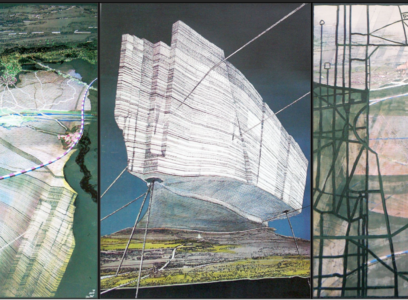
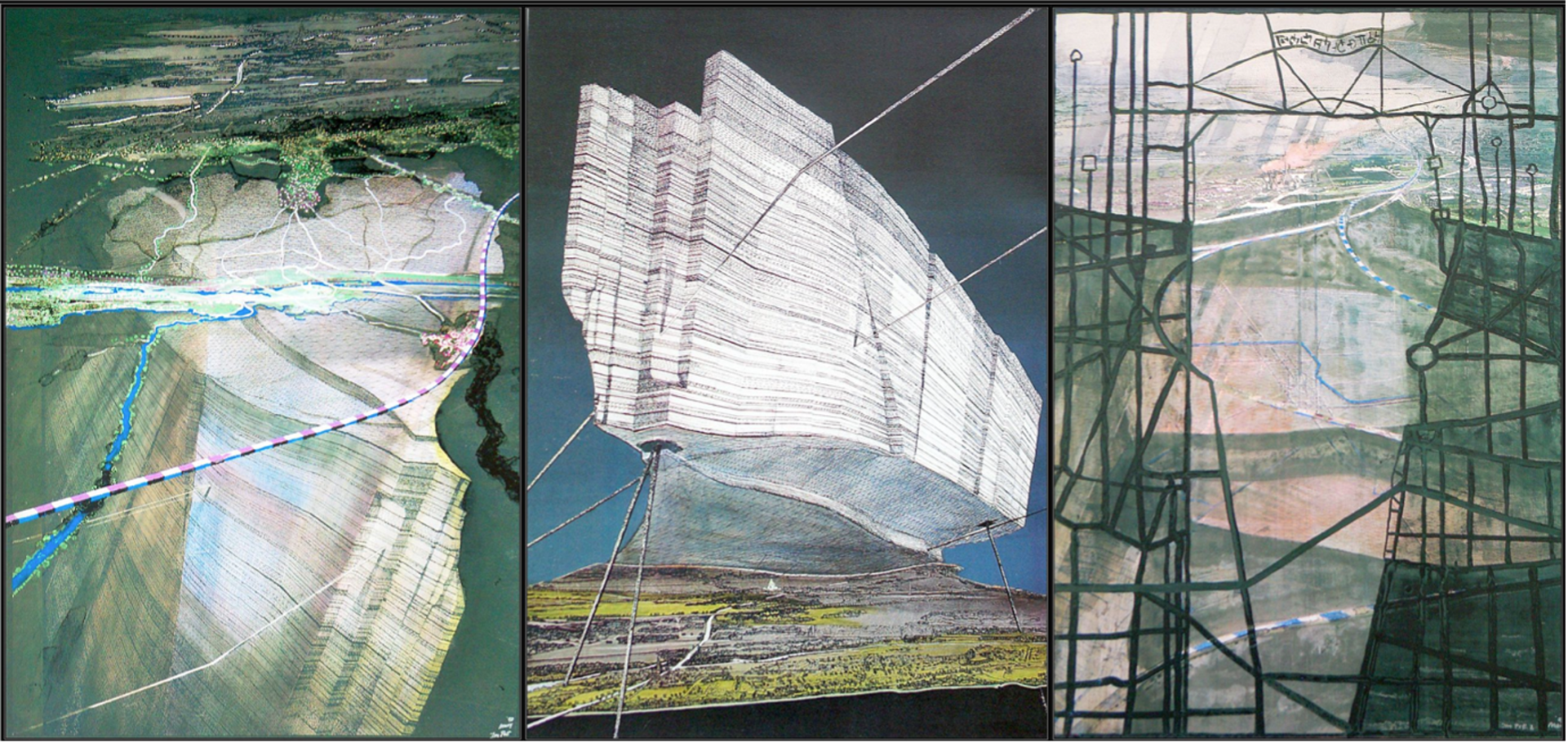
 Once a major centre of heavy industries in Europe, Germany’s Ruhr Valley is transitioning into a postcarbon, climate-adjusted ecology and economy. Scholars studying the Ruhr’s “great transformation” as well as key actors in this transformation readily acknowledge that the return of nature above ground depends on the high-tech management of the underground. Approaching this mining and postmining ecology as an instantiation of “subterranean Anthropocene” (Melo Zorita, Munro and Houston 2017), I explore visualisations of the Ruhr’s subterrain in museum exhibits, art, films, maps, and AR/VR applications that reveal contradictions and punctuations in the linear history of socio-technological development. My aim is to trace the implausibility of the modern narrative of extractivist progress and to make tangible alternative assemblages of meaningful human-environment relationships in an industrial Western cultural lifeworld.
Ute Eickelkamp is a social anthropologist affiliated with the School of Communication, University of Technology Sydney. She held positions as Stipend Recipient at the German Mining Museum-Bochum, as Senior Research Fellow at the Institute for Social Movements, Ruhr University Bochum, as an ARC DECRA (Charles Darwin University) and as an ARC Future Fellow (University of Sydney) – while observing the eventful transformation of her childhood world of smokestacks and open sewers, the Ruhr, into a green Metropolis. Her ethnographic research focuses on emergent images of nature in the face of climate change and ontological duress, in contexts of Indigenous survivance and postindustrial precarity in Central Australia and Germany respectively. She writes about water, slag heaps, the underground, art, imagination, care and temporality.

The session is moderated by Milena Bister.
For the session, preparation materials are available. To receive them, please contact: alex.marlin.maurer@hu-berlin.de
Everybody is very welcome to join!
Thursday, 12 February 2026
10:00 – 11:30 am, (s.t.!)
online only!!
We are meeting on Zoom, for the link, please contact: alex.marlin.maurer@hu-berlin.de.