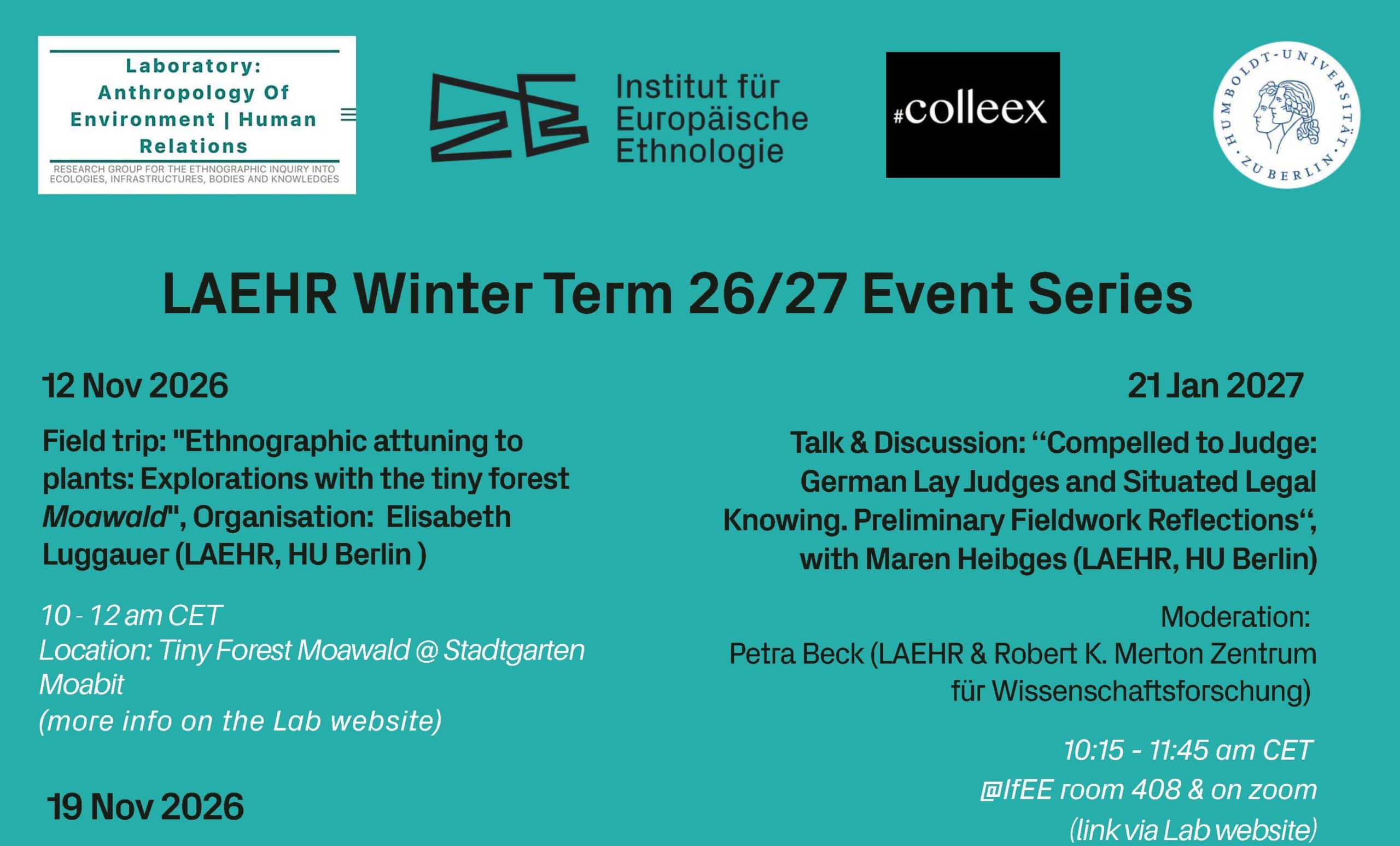
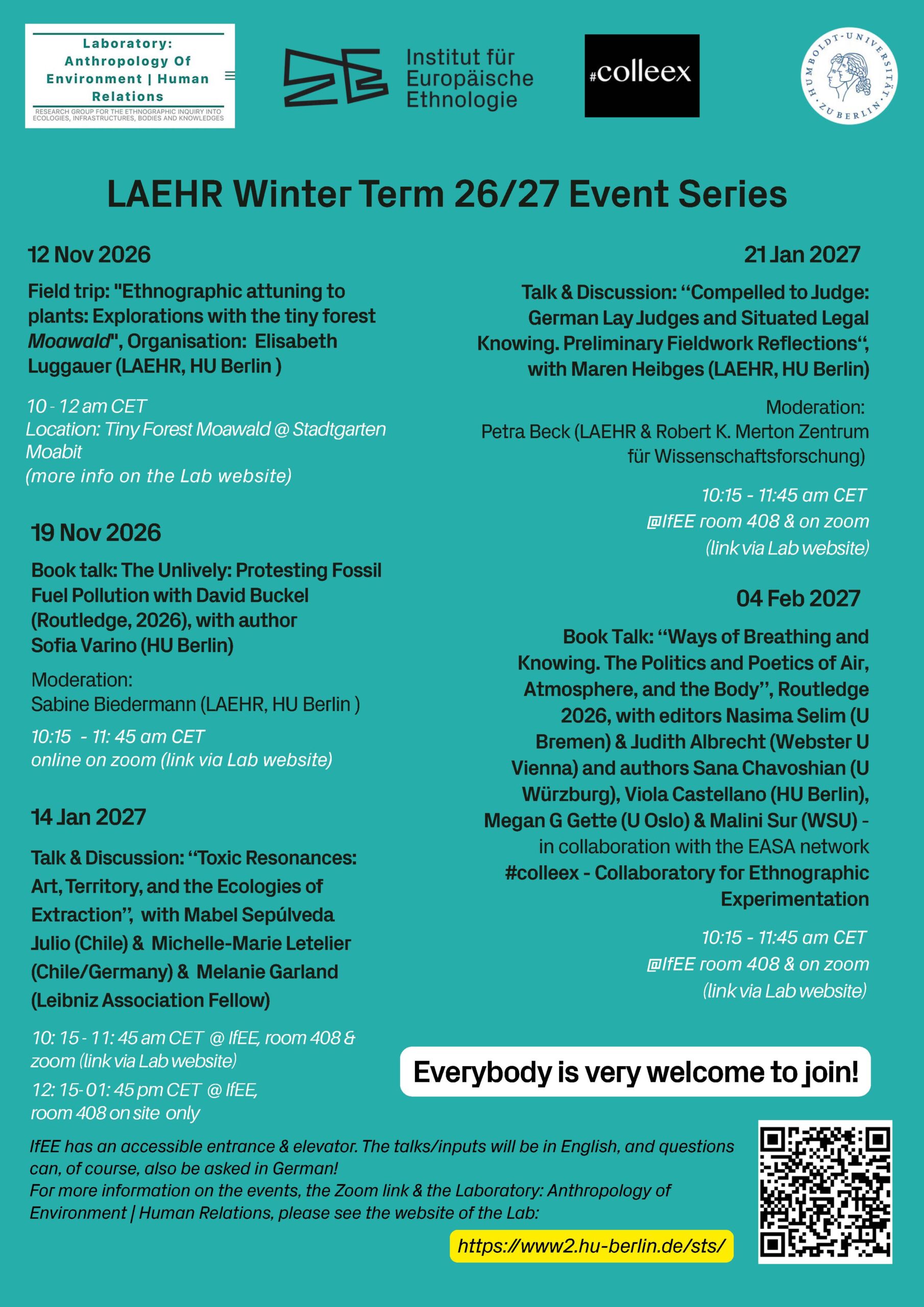
12.11.2026
Field trip: “Ethnographic attuning to plants: Explorations with the tiny forest Moawald”
A core question in plant ethnography is: How can human sensoria and learned modes of perception capture the existences, lifeworlds, and practices of world-shaping through and among plants? This certainly requires experimentality, creativity, and a commitment to transdisciplinarity. In this field trip, we want to explore possibilities of ethnographic attuning to plants by engaging with the Moawald, a tiny forest in the center of Berlin.
We will do this guided by two approaches, open for participants to choose:
a) Experimenting with how to sense (with) plants, following Natasha Myers and Ayelen Liberona’s explorations of sensing botanical sensoria and becoming sensor toward plants
b) acting as “urban field naturalist”, mobilizing a Guide to Staring at Flowers, developed by The Urban Field Naturalist Project, for attuning to an urban forest in autumn mood
Organization: Elisabeth Luggauer ( Lab Anthropology of Environment | Human Relations, HU – Berlin)
Thursday, November 12, 2026
10 – 12 am CET
Location:
Tiny Forest Moawald @ Stadtgarten Moabit (wheelchair accessible) on-site only
Exact location: https://www.openstreetmap.org/?mlat=52.534354&mlon=13.337215#map=18/52.534356/13.337215
We will be outdoors. Please come adequately equipped for that day’s weather.
For questions or to receive the optional reading for preparation, please write to: elisabeth.luggauer@hu-berlin.de
Suggested reading for preparation (optional):
Myers, Natasha & Liberona, Ayelen: “Becoming Sensor in Sentient Worlds”, https://becomingsensor.com/.
Myers, Natasha. 2017. “Ungrid-able Ecologies: Decolonizing the Ecological Sensorium in a 10,000-year-old NaturalCultural Happening”, Catalyst: Feminism, Theory, Technoscience, 3(2) 1-24.
Myers, Natasha. 2014. Sensing Botanical Sensoria. A Kriya for Cultivating your Inner Plant. Centre for Imaginative Ethnography, Imaginings Series, http://imaginativeethnography.org/imaginings/affect/sensing-botanical-sensoria/.
Ertl, Cornelia, Susanne Schmitt und Sandra Calkins. 2025. “Pflanzenethnographie.” Handbuch Umweltethnologie, edited by Kathrin Eitel and Carsten Wergin. Springer VS: 185-204. https://link.springer.com/chapter/10.1007/978-3-658-45341-1_8.
Elton, Sarah. 2021. Growing Methods: Developing a Methodology for Identifying Plant Agency and Vegetal Politics in the City. Environmental Humanities 13 (1): 93–112. https://doi.org/10.1215/22011919-8867219.
The Urban Field Naturalist Project. 2022. A Guide to the Creatures in Your Neighborhood. Sydney Murdoch Books, pp. 92-100.
***
19.11.2026
Book talk: The Unlively: Protesting Fossil Fuel Pollution with David Buckel (Routledge, 2026)
by Sofia Varino (Lab Anthropology of Environment | Human Relations, HU Berlin)
The Unlively: Protesting Fossil Fuel Pollution with David Buckel examines air pollution and extinction by looking into how they might contribute, conceptually and politically, to a queer ecopolitics of death. It focuses on the figure of David Buckel, an American LGBT rights lawyer and environmentalist, who self-immolated to protest fossil fuel pollution in 2018. The author considers Buckel’s death as an act of political protest, whereby a (singular) living body attacks itself as a response to the (collective) extinction of non/human life forms. The book mobilizes the materiality of death and non/human extinction, proposing the concept of the “unlively” as that which negates life or is incapable of vitality, to account for Buckel’s self-immolation as well as the deadly effects of fossil fuel air pollution.
Sofia Varino is an author and academic based in Berlin. With a focus on political ecology and planetary health, their research and teaching interests include environmental and medical humanities, queer and feminist epistemologies, and transnational American studies. They are the author of The Unlively: Protesting Fossil Fuel Pollution with David Buckel (Routledge, 2026) and co-author of Aquatopia: Climate Interventions (Routledge, 2023). They teach at Humboldt University of Berlin.
BlueSky and Instagram: @sofiavarino // Website: sofiavarino.com
Moderation: Sabine Biedermann (Lab Anthropology of Environment | Human Relations, HU Berlin)
Thursday, 19. 11. 2026
10:15 – 11:45 am CET
Online on Zoom (link via sabine.bc@gmail.com)
***
14.01.2027
Talk & Discussion: Toxic Resonances: Art, Territory, and the Ecologies of Extraction
with Mabel Sepúlveda Julio (Chile) & Michelle-Marie Letelier (Chile/Germany) & Melanie Garland (Leibniz Association Fellow & Lab Anthropology of Environment | Human Relations, HU Berlin)
This session brings together artists and researchers Mabel Sepúlveda Julio, Michelle-Marie Letelier, and Melanie Garland to examine the complex legacies of toxic heritage across landscapes, materials, and multispecies worlds. Framed by readings from Toxic Heritage: Legacies, Futures, and Environmental Injustice (Elizabeth Kryder-Reid & Sarah May, eds.), participants are invited to consider how environmental harm and industrial extraction shape both pasts and possible futures, particularly from a Global South perspective. Through three interconnected projects, the speakers explore how artistic practice can amplify, critique, and reimagine the toxic inheritances embedded within ecological and cultural heritage.
Mabel Sepúlveda Julio focuses on the industrial traces that have shaped histories and lives around mining extraction in the Atacama Desert (copper and silver), examining how this post-industrial landscape produces an identity closely tied to mining—one that has evolved into a developed industry with new local political, economic, and cultural effects. Michelle-Marie Letelier, through her artistic research Transhemispheria, investigates cross-hemispheric relations within the context of contemporary planetary tensions: the kinship, insertion, farming, and impact of salmon; the anthropocentric management and manipulation of marine life; and the coexistence—and gradual disappearance—of ancestral knowledge within artistic and scientific frameworks. Melanie Garland presents the soundwalk “Maritime Deep Resonances,” created in collaboration with cultural scholar Melcher Ruhkopf and set aboard the historic sailing ship Peking in Hamburg. This work bridges the history of the nitrate trade from the Atacama Desert to Europe with contemporary lithium extraction, transforming collective listening into acts of ecological resonance and reimagination, while confronting the cycles of exhausted landscapes that define toxic heritage. Together, these projects at the intersection of art and science invite us to listen and to reimagine new futures for heritage, care, and ecological justice.
The first session (10:15–11:45, hybrid) will feature presentations by Michelle-Marie Letelier and Mabel Sepúlveda Julio, moderated by Melanie Garland. The second session (12:15–13:45, in situ) will focus on a talk and participatory discussion led by Melanie Garland with IfEE students of “Heritage Ecologies” (Prof. Magdalena Buchczyk). While this block is designed within the course framework and takes place outside regular LAEHR Lab hours, the public is warmly welcome to stay and participate in the conversation.
Reading suggestion: Toxic Heritage: Legacies, Futures, and Environmental Injustice (Elizabeth Kryder-Reid & Sarah May, eds.). Book chapter TBD
Mabel Sepúlveda Julio is a visual artist based in Copiapó, Chile. Her work mobilizes painting, textiles, and non-traditional materials to explore landscape, memory, and industrial heritage. She has exhibited widely in Chile and internationally, and has curated community-focused projects in the Atacama Desert region. Sepúlveda holds a Master’s in Visual Arts from the University of Chile and is a recipient of multiple national and international awards and residencies, including the 2025 ACHTERHAUS residency in Hamburg.
Michelle-Marie Letelier is a Chilean artist based in Berlin whose multidisciplinary work orchestrates transformations of so-called ‘natural resources’ through research, installation, and performance. Her practice explores the political, historical, and ecological legacies of extractivism, with a focus on material culture such as copper, coal, nitrate, and salmon. Letelier’s work has been exhibited internationally at institutions including Gropius-Bau (Berlin), Museo de la Solidaridad Salvador Allende (Santiago), and Kunstmuseum St. Gallen (Switzerland), and she has participated in major biennials and residencies worldwide.
Melanie Garland is a Berlin-based artist-researcher and scholar whose work connects art, anthropology, and cultural heritage. Holding a PhD from Humboldt University, she specializes in object-based installations, sound performances, and curatorial projects rooted in feminist and decolonial ethics of care. Her research explores multispecies ecologies and the sonic dimensions of oceans and deserts, focusing on postcolonial histories of extraction and transformation between Germany and Chile. Garland is currently affiliated with the Berlin-Brandenburgische Landesstelle für Alltagskultur (IfEE) and the Deutsches Schifffahrtsmuseum, Leibniz-Institut für Maritime Geschichte.
Thursday, January 14, 2027
Session 1 (Hybrid): 10:15 –11:45
Presentations by Michelle-Marie Letelier & Mabel Sepúlveda Julio
Moderation: Melanie Garland
@IfEE, Room 408 & on Zoom
Session 2 (on-site only): 12:15–13:45
Participatory talk & discussion with Melanie Garland
as part of the course “Heritage Ecologies” (Magdalena Buchczyk)
Everybody is very welcome to join both sessions!
Zoom link for the first session via m@melaniegarland.com
***
21.01.2027
Talk & Discussion: Compelled to Judge: German Lay Judges and Situated Legal Knowing: Preliminary Fieldwork Reflections
with Maren Heibges (Lab Anthropology of Environment | Human Relations, IfEE, HU Berlin)
This work-in-progress talk draws on ethnographic fieldwork from the position of a German lay judge. It explores how citizens compelled to judge are positioned within a legal knowledge process they only partly access: asked to assess what is staged in court while remaining largely detached from its prior mobilisation. I use this tension to think about situated legal knowing, decision-making, and actualized state authority.
Maren Heibges is an anthropologist and STS scholar working primarily at the intersection of medical anthropology, the anthropology of knowledge, and Science and Technology Studies. Her research examines how technologies, regulations, bodies, and expertise shape decision-making, practices of work and care, and wider patterns of social and political life. She studied European Ethnology in Berlin and Science and Technology Studies at the University of Exeter, UK. She is currently Visiting Professor of European Ethnology at the IfEE Berlin and, on leave, Deputy Head of the Division of Ergonomics at Technische Universität Berlin.
Moderation: Petra Beck (Robert K. Merton Zentrum für Wissenschaftsforschung & Lab Anthropology of Environment | Human Relations, HU Berlin)
Thursday, 21. 01. 2027
@ IfEE, room 408 & on Zoom
10:15 – 11:45 am CET
Zoom link via petra.beck@hu-berlin.de
***
04. 02. 2027
Book Talk: Ways of Breathing and Knowing. The Politics and Poetics of Air, Atmosphere, and the Body
with editors Nasima Selim (University of Bremen) & Judith Albrecht (Webster University Vienna), and authors Sana Chavoshian (U Würzburg), Viola Castellano (HU Berlin),
Megan G Gette (U Oslo) & Malini Sur (WSU)
This book studies the multiple ways of breathing (in) and knowing (of) contemporary lifeworlds. It offers a collection of ethnographic and interdisciplinary essays articulating the politics and poetics of air, atmosphere, and the body across diverse geographical locations, historical moments, and theoretical approaches. The book argues that air, atmosphere, and the body are relational entities shaping and shaped by the very act of breathing. It shows how differences in air, atmosphere, and the body at the scales of neighborhoods, regions, nation-states, and the planet co-constitute breathing inequalities and respiratory conditions of possibilities in suffocating times.
Jointly organized with the EASA network #colleex – collaboratory for ethnographic experimentation
Moderation: (Lab Anthropology of Environment | Human Relations, HU Berlin & #colleex )
Thursday, 04. 02. 2027
@IfEE, room 408 & on Zoom
10:15 – 11:45 am CET
Zoom link via elisabeth.luggauer@hu-berlin.de
*****
Accessibility:
The IfEE building has an accessible entrance and elevator; room 408 is located on the 4th floor; accessible bathrooms are on the ground floor.